Manish Choudhary
CEO & Co-founder, Ferry | Flexprice

Ferry: Best for B2B companies automating billing, collections, and revenue recognition end to end
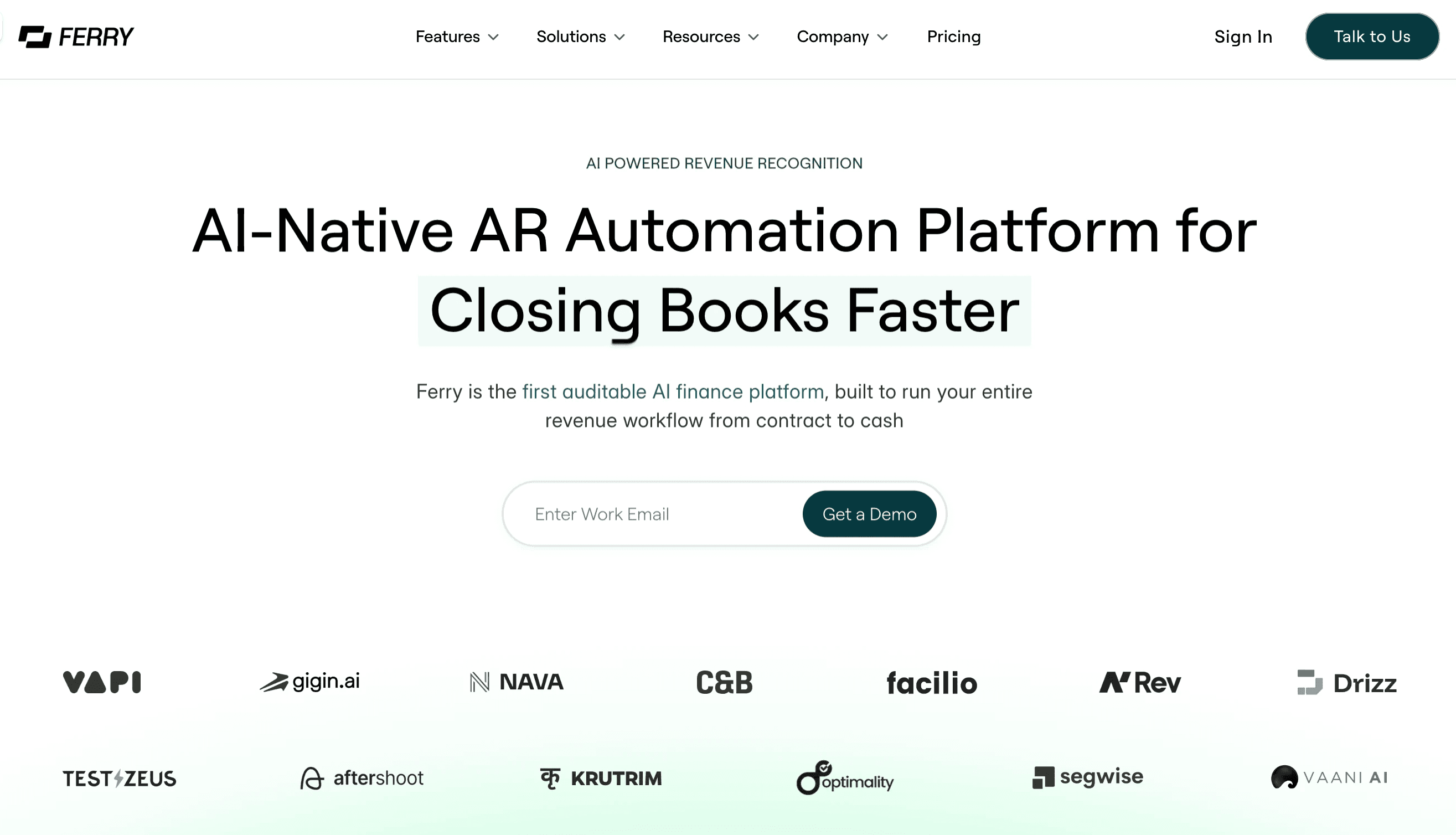
Ferry is an AI-native revenue recognition and finance software that runs the full contract-to-cash cycle through a single AI agent. Billing, collections, and revenue recognition in one platform is the core difference between Ferry and every other tool on this list. Ferry AI is compliant with all the compliance requirements such as ASC 606, SOC 2 and GAAP this means every piece of data and information is safe and secure.
The billing side handles any pricing models such as API calls, seats, outcomes, annual subscriptions, usage-based, and hybrid structures. Ferry ships with its own native billing tool, but it also runs on top of your existing billing stack so you don't have to replace what you already have.
Ferry's AI agent turns a signed contract into a billing schedule and invoice automatically, ingests amendments and pricing changes in real time, and recalculates without manual input. Companies using it have reported 80% reductions in billing time and 3x improvements in accuracy.
Collections run the same way. The AI agent executes dunning sequences customized by customer type, matches incoming payments to open invoices, resolves partial payments and duplicates, and posts reconciliation to your ERP. A live dashboard tracks DSO, AR aging, and at-risk accounts before they become bad debt.
Revenue recognition posts journal entries directly into NetSuite, QuickBooks, or Sage Intacct and logs the contract clause, recognition rule, and result for every revenue line. ARR waterfalls, deferred revenue schedules, and cash forecasts update in real time from contracts, bookings, and usage data. The audit trail isn't a separate feature, it's how the system works.
Best for- B2B companies automating billing, collections, and rev rec end to end
Audit trail depth- 5/5
Hybrid contract support- 5/5
Pricing: Contact for pricing
Pros:
Full contract-to-cash automation in one platform billing, collections, rev rec, and reporting
Handles any pricing model: subscriptions, usage-based, seats, outcomes, hybrid
Works on top of your existing ERP with no migration required
Every revenue line traced to the contract clause that authorized it, audit-ready by default
Cons:
Ferry AI can be an overkill if you just have a handful of customers
NetSuite: Best for enterprises already on NetSuite
NetSuite's module brings revenue recognition into the same ERP where you already manage GL, AP, AR, and payroll. For companies standardized on NetSuite, the argument is straightforward: no integration overhead when your contract data, invoicing, and general ledger already live in the same system.
ARM supports straight-line, milestone, usage-based, and hybrid recognition methods. It covers the ASC 606 five-step framework and carries the audit controls you'd expect from an Oracle product.
What the reviews consistently flag: ARM is structurally complex in ways that shouldn't be. One IT and services finance professional on G2 wrote that the module is "really clunky, too many layers to (Arrangement, Element, Plan why???)" and that subscription amendments are "too limiting" unless NetSuite is also your CRM and quoting system. Implementation averages 6 months.
The average discount of 26% on purchases suggests there's negotiation room, but the base cost is still significant.
If your contracts are relatively standard and you're already on NetSuite, ARM is the easiest path forward. The integration overhead you'd otherwise pay to connect a separate rev rec tool to your GL, AR, and invoicing simply doesn't exist here.
Best for: Enterprises standardized on NetSuite ERP
Audit trail depth: 3/5
Hybrid contract support- 3/5
Pricing: Contact them to know more
Pros:
Single source of truth when your full stack runs on NetSuite
Supports straight-line, milestone, usage-based, and hybrid recognition methods
Largest implementation partner ecosystem in the market
Extensive customization via SuiteScript and workflows
Cons
ARM requires too many configuration layers for tasks that should be simple
Subscription amendment handling is limited without NetSuite as your CRM
6-month average implementation time
Admin involvement required for most changes; steep learning curve
Maxio: Best for SaaS companies with subscription billing and moderate rev rec complexity
Maxio came from merging SaaSOptics, a revenue recognition and metrics platform, with Chargify, a subscription billing tool. The combined product covers the full subscription lifecycle: billing, collections, revenue recognition, and SaaS metrics reporting. For software companies past the spreadsheet stage but not yet at enterprise complexity, it's the most purpose-built subscription revenue recognition software on this list.
For pure subscription businesses, revenue recognition schedules are automated and ASC 606-compliant. The SaaS metrics layer is genuinely useful: cohort revenue analysis, churn tracking, and ARR waterfall reports all come from the same data set as your rev rec schedules, which isn't true of most tools.
Reporting is where Maxio consistently falls short. One VP of Finance in a mid-market company on G2 wrote: "Maxio still has a ways to go in terms of reporting and process efficiencies. The shortfall on the reporting side cannot be understated." A lot of reviewers mention exporting to Excel regularly for analysis that should happen in-product.
Running both a product-led growth motion and a direct sales motion simultaneously creates complexity between the two billing systems Maxio inherited from the merger, and that shows up in reporting and product catalog management.
Best for: B2B SaaS companies with subscription billing and moderate rev rec complexity
Audit trail depth- 2 out of 5
Hybrid contract support- 3 out of 5
Pricing From- $599/month
Pros
Purpose-built for SaaS subscription models, billing and rev rec in one product
Strong SaaS metrics: MRR, ARR, cohort analysis from the same data set as recognition schedules
Good Salesforce and QuickBooks integrations
Cons
Reporting is the consistent weak point; many users end up in Excel
PLG plus sales-led billing creates complexity between Maxio's two systems
Data migration and setup time is significant
Non-standard configuration requires paid support hours
4. Sage Intacct: Best for mid-market companies with multi-entity structures and compliance requirements
Sage Intacct is a cloud-native accounting platform built on financial reporting depth, multi-entity consolidation, and compliance controls. Its revenue recognition module supports ASC 606 and IFRS 15, automates recognition schedules, and includes audit controls designed for companies heading into external audit or investor scrutiny.
The platform has strong mid-market penetration, particularly in companies with multiple subsidiaries or international operations. Its dimensional chart of accounts is one of the most differentiating features on this list: you can tag and analyze revenue across entities, locations, and product lines without multiplying GL accounts.
Several reviewers cited the audit controls as the reason they stayed after evaluating alternatives. Worth knowing before you buy: revenue recognition is a module in Sage Intacct, not the core product.
Some Capterra reviewers noted that rev rec "does not always reliably post" and that controls are less flexible than dedicated platforms. The interface gets described repeatedly as dated and dense for new users, and advanced configurations require partner support. For companies whose primary complexity is multi-entity structure, investor reporting, or international consolidation, those trade-offs are usually worth it.
Best for: Mid-market companies with multi-entity structures and audit/investor compliance needs
Audit trail depth- 4/5
Hybrid contract support- 3/5
Pricing: Contact the team for pricing details
Pros
Best-in-class multi-entity and multi-currency consolidation
Dimensional chart of accounts enables flexible reporting without GL proliferation
Strong audit controls, cited by reviewers as a reason to stay
Broad integrations, including Salesforce
Cons
Revenue recognition module is less reliable than dedicated tools; "does not always reliably post"
Interface is dated with a steep learning curve for new users
Advanced features require implementation partner support
Not built for usage-based or hybrid pricing structures
5. Leapfin: Best for high-volume transaction businesses needing automated revenue subledgers
Leapfin is an AI-powered revenue recognition and reconciliation platform for companies B2B companies. Marketplace platforms, e-commerce businesses, usage-based SaaS companies where transactions run into the hundreds of millions per month: that's the use case Leapfin was built for.
It's a data engine at its core. Leapfin ingests transaction data from Stripe, Adyen, Braintree, and other payment processors, applies rules-based accounting logic, and generates daily transaction-level journal entries that post to your GL. The audit trail is immutable, meaning entries can't be modified retroactively, which is what makes the output defensible under audit.
Only 6 G2 reviews exist for Leapfin, which is a small base. One of those reviewers gave a 1.5/5 after a 5-month implementation that produced no usable out-of-the-box reporting for a non-standard B2B SaaS stack. Multiple reviewers flagged a steep learning curve in configuration and rule-setting, and implementation currently requires Leapfin support involvement rather than self-service. The platform is optimized for high-volume, relatively standardized transaction types and gets significantly harder with complex B2B contracts.
Best for: High-volume transaction businesses, marketplaces, and usage-based SaaS companies
Audit trail depth: 5/5
Hybrid contract support: 4/5
Pricing: Contact the team to know more about the pricing
Pros
Handles hundreds of millions of transactions with automated daily journal entries
Immutable audit trail at the transaction level
AI-powered data querying without an engineering dependency
Out-of-the-box payment processor integrations (Stripe, Adyen, Braintree)
Cons
Only 6 G2 reviews: a small sample for a platform decision of this size
Configuration and rule-setting require a real learning investment
Implementation requires Leapfin support involvement; customers can't self-serve complex updates
Less suited to complex B2B enterprise contracts
How to choose revenue recognition software?
Your existing stack
A dedicated rev rec tool that sits outside your ERP introduces an integration layer you'll have to maintain. A module built into your ERP eliminates that overhead but may limit flexibility. The question to ask: does this system connect to your GL, CRM, and billing stack without custom engineering, and who owns that connection when something breaks?
Your pricing model
Straight-line subscription recognition is table stakes. The real test is whether the system handles the contracts you actually sign: usage components, committed minimums, variable consideration, mid-year amendments, and multi-year deals with different rates across periods. If your contracts are standard, most tools here will work. If they're not, that narrows the list quickly.
Transaction volume vs. contract complexity
These are different problems. High transaction volume at relatively standard terms needs a data engine that can process at scale without manual intervention. Complex B2B contracts with frequent changes need a system that tracks every modification and reallocates revenue correctly. Some tools solve one well; fewer solve both.
Implementation and ownership
Six months of implementation with a third-party consultant is a real cost. So is a system that requires admin involvement every time a contract changes. Ask vendors how long it takes to process a contract amendment, and whether your team can do it without opening a support ticket.
Company size and growth trajectory
A tool that works for a 50-person SaaS company may not hold up when you're preparing for a Series C audit or consolidating across three subsidiaries. Build headroom into the evaluation, not just fit for today.
Which revenue recognition software is right for your business?
The best revenue recognition software for your company is the one that fits where your complexity actually lives, not the one with the most features or the longest customer list.
A pure subscription business at the growth stage has different needs than a multi-entity company consolidating across subsidiaries, or a marketplace processing millions of transactions monthly, or a B2B platform that wants billing, collections, and rev rec automated end to end without replacing its ERP. All five tools on this list are GAAP and ASC 606 compliant. That's not the decision. Fit is.
Before you book a demo, walk in with your hardest contract type, your current close timeline, and the question your last auditor asked. Ask each vendor how their system handles that exact case, how long it takes, who needs to be involved, and whether your team can do it without opening a support ticket. Those three answers tell you more about real operating cost than any pricing page.
Revenue recognition software is moving fast. AI-native platforms that automate the full contract-to-cash cycle are raising what finance teams expect from the category. The tools that hold up are not just the ones that recognize revenue correctly, they're the ones that can show why, adapt when contracts change, and scale without adding headcount.
(Sources: RightRev CFO Survey of finance leaders at SaaS companies with 200-5,000 employees; Leapfin State of Automation for Revenue Accounting, 2025; verified G2 and Capterra user reviews for NetSuite, Maxio, Sage Intacct, and Leapfin)
What is the difference between revenue recognition software and billing software?
How does ASC 606 affect deferred revenue?
What does "auditable" mean in revenue recognition software?
What is the best revenue recognition software for B2B companies with usage-based pricing?