
Manish Choudhary
CEO & Co-founder, Ferry | Flexprice

Most overdue invoices are not refusals to pay. They are invoices that got buried under an approval chain, a switched contact, or a busy month. The letter you send next, and the day you send it, usually decides whether you get paid or get filed under "deal with later."
TL;DR
A dunning letter is a formal reminder about an overdue invoice, sent as one step in a collections sequence that escalates in tone as the invoice ages.
A typical sequence runs three to five stages, from a friendly nudge near the due date to a final notice before collections or legal action.
Specific letters get paid. One invoice, one amount, one payment link, one deadline. Vague ones get ignored.
The right letter depends on current receivables data. A final demand sent to someone who paid last week costs you the relationship, not the cash.
What is a dunning letter?
A dunning letter is a formal written notice that a business sends to a customer about an overdue invoice, asking for payment by a specific date. It is part of the accounts receivable process, the function that tracks money customers owe you and works to collect it.
The word sounds old because it is. "Dunning" comes from the 17th-century verb "to dun," which meant to make repeated, insistent demands for payment of a debt. The tool has changed (most dunning now goes out by email, not a wax-sealed envelope), but the job is the same: remind, escalate, and recover.
Dunning letter vs collection letter vs payment reminder
These terms describe the same thing, with small differences in tone. A dunning letter, a dunning notice, and a collection letter all refer to a formal request for an overdue payment. "Payment reminder" usually signals the gentler, earlier end of that range, the kind you send before an invoice is even late. In practice, teams use the words interchangeably, so do not get hung up on which label your accounting software uses.
Why do dunning letters still matter?
They matter because late payment is widespread, expensive, and rarely solves itself. Dun & Bradstreet's Q3 2023 U.S. Accounts Receivable and DSO Industry Report found that in the social services sector, 72.4% of receivables dollars were 91 or more days overdue, with several repair-services industries above 22% in that same severely delinquent bucket. Those are not rounding errors. That is working capital frozen on a balance sheet.
There is also a capacity problem behind the cash problem. In Leapfin's 2025 State of Automation for Revenue Accounting survey (n=200), 73% of finance teams said the business was growing faster than they could keep up with. When order volume climbs and the AR team does not, manual follow-up is the first thing that slips. A consistent dunning process is how you keep collecting when you no longer have time to chase every account by hand.
What does the dunning sequence look like?
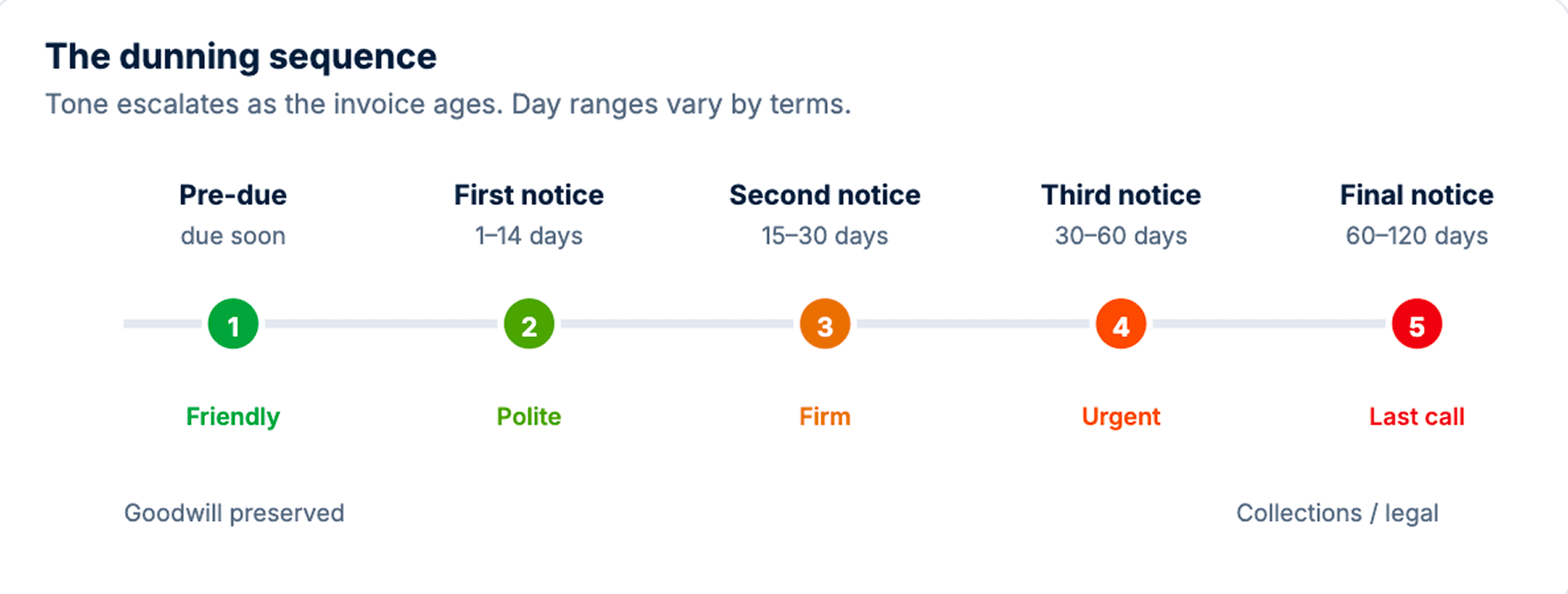
A dunning sequence is a staged ladder of reminders tied to how many days an invoice is past due. Each stage gets firmer, and each one assumes a little less good faith than the last. Here is the shape most teams use, though the exact day intervals vary by company and payment terms.
Pre-due or due-date reminder. Friendly and low-stakes. "This invoice is due in three days, here's the link." This stage prevents far more late payments than people expect.
First notice (1 to 14 days past due). Polite, assumes an oversight. Restates the invoice number, amount, and a fresh due date.
Second notice (15 to 30 days). Firmer. Repeats the details, references the original terms, and mentions any late fee that applies.
Third notice (30 to 60 days). Urgent. Names specific consequences, such as a hold on services or escalation to a collections process.
Final notice (60 to 120 days). The last warning before you hand the account to a collections agency or legal counsel. Clear, factual, and dated.
The point of the ladder is not to threaten. It is to give a busy, well-meaning customer several clear chances to pay before the relationship turns adversarial.
What should every dunning letter include?
Every effective dunning letter carries the same seven pieces of information, so the customer never has to hunt for what to do. Include the invoice number, the original due date, the exact amount owed including any late fees, a single clear way to pay (ideally a payment link), a specific new deadline, the consequence of missing it, and a contact for questions or disputes. Drop any one of those and the letter becomes one more thing to deal with later.
Why specificity beats tone
The thing that gets an invoice paid is clarity, not politeness and not pressure. A line like "please remit payment of your outstanding balance at your earliest convenience" sits unread because it gives the reader nothing to act on. Compare it with: "Invoice 1042 for $4,750, due March 15, is unpaid. Pay by card or bank transfer here. Payment by March 22 avoids a $95 late fee." Same situation, completely different result, because the second one tells the customer exactly what, how much, and by when.
One more habit that helps: one invoice per letter. Combining five overdue invoices into a single email creates decision friction, and a customer who cannot quickly process all of it tends to process none of it. Separate invoices, separate reminders.
The most common dunning mistake: one sequence for everyone
The biggest mistake I see is sending the same letter ladder to every customer. An enterprise account with a procurement department and a self-serve user who forgot to update a card are not the same problem, and a single generic cadence handles both of them badly. The enterprise account needs a formal tone and a longer runway. The self-serve user needs a quick, friendly card-update nudge, not a letter that reads like a legal threat over $90.
Good collections segments the sequence by who the customer is: enterprise, self-serve, high-value, late payer, at-risk. Each cohort gets a tone and a cadence that fits it. Doing that by hand across hundreds of accounts is where most teams give up, which is exactly the work that automation is built for.
How Ferry's AI agent runs dunning per customer
Ferry's AI agent runs a different dunning sequence for each customer cohort automatically, so the enterprise account and the self-serve user each get the right tone without anyone building two separate workflows. Ferry runs ready-made playbooks for distinct situations, including a Standard Reminder, a High-Value Account track for invoices over $5,000, a PLG/Self-Serve cadence, an Enterprise track with longer intervals, a Failed Payment retry, and an At-Risk Customer flow that loops in the account owner.
The agent sends those reminders by email or Slack with a payment link embedded, and it reads incoming bank data to apply cash on its own, so the next reminder reflects what a customer has actually paid rather than a week-old snapshot. That matters more than it sounds: nothing damages a relationship faster than a stage-four demand landing in the inbox of someone who paid on Tuesday.
One finance lead, Ram A., put the result this way: "Honestly, AR used to be the thing that kept us up before month-end. Ferry automated the entire collections workflow and we cut DSO by over 60%. The books just close seamlessly now." Across customers, Ferry reports 95% of invoices generated on time. You can see how the collections automation handles the per-cohort sequencing in more detail.
Dunning letter templates
Below are four templates that escalate from a friendly reminder to a final notice. Swap the bracketed fields for your details, keep one invoice per message, and always include a payment link.
1. Friendly reminder (around the due date)
Subject: Invoice [#] due [date]
Hi [Name], a quick heads-up that invoice [#] for [amount] is due on [date]. You can pay here: [link]. If you've already sent this, thank you, and please ignore the reminder. Any questions, just reply to this email.
2. Second notice (15 to 30 days past due)
Subject: Invoice [#] is now past due
Hi [Name], invoice [#] for [amount], originally due [date], is now [X] days past due. Please arrange payment here: [link]. Per our terms, a late fee of [amount] applies after [date]. If something is holding up payment on your end, let me know and we'll sort it out.
3. Third notice (30 to 60 days past due)
Subject: Action needed on invoice [#]
Hi [Name], invoice [#] for [amount] remains unpaid [X] days after its due date, despite earlier reminders. Please pay the full balance of [amount including fees] by [date] here: [link]. If we don't receive payment or hear from you by then, we'll need to pause [service/account] while we resolve this.
4. Final notice (60+ days past due)
Subject: Final notice before collections, invoice [#]
Hi [Name], this is a final notice on invoice [#] for [amount including fees], now [X] days overdue. If payment is not received by [date], we will refer this account to [collections agency / our legal team] for recovery. To avoid that, pay in full here: [link], or contact me directly today to arrange terms.
The letter matters less than the system behind it
A dunning letter is only as good as the data and the timing behind it. The wording helps, the templates help, but the real lever is sending the right stage to the right customer based on what is actually outstanding today. Start by auditing your current sequence against the five stages above, then check one thing: is your follow-up reacting to live receivables data, or to last month's close? If it is the latter, that gap is where your cash, and your customer goodwill, is quietly leaking.